Plan capital expenditure with full financial visibility.
IDU enables organisations to capture, model, and manage capital expenditure within the broader financial plan. Capex budgets are linked to asset classes, depreciation rules, and reporting structures, ensuring the financial impact of capital decisions is understood before commitments are made.
From capital request to financial impact.
Capture capex where decisions are made.
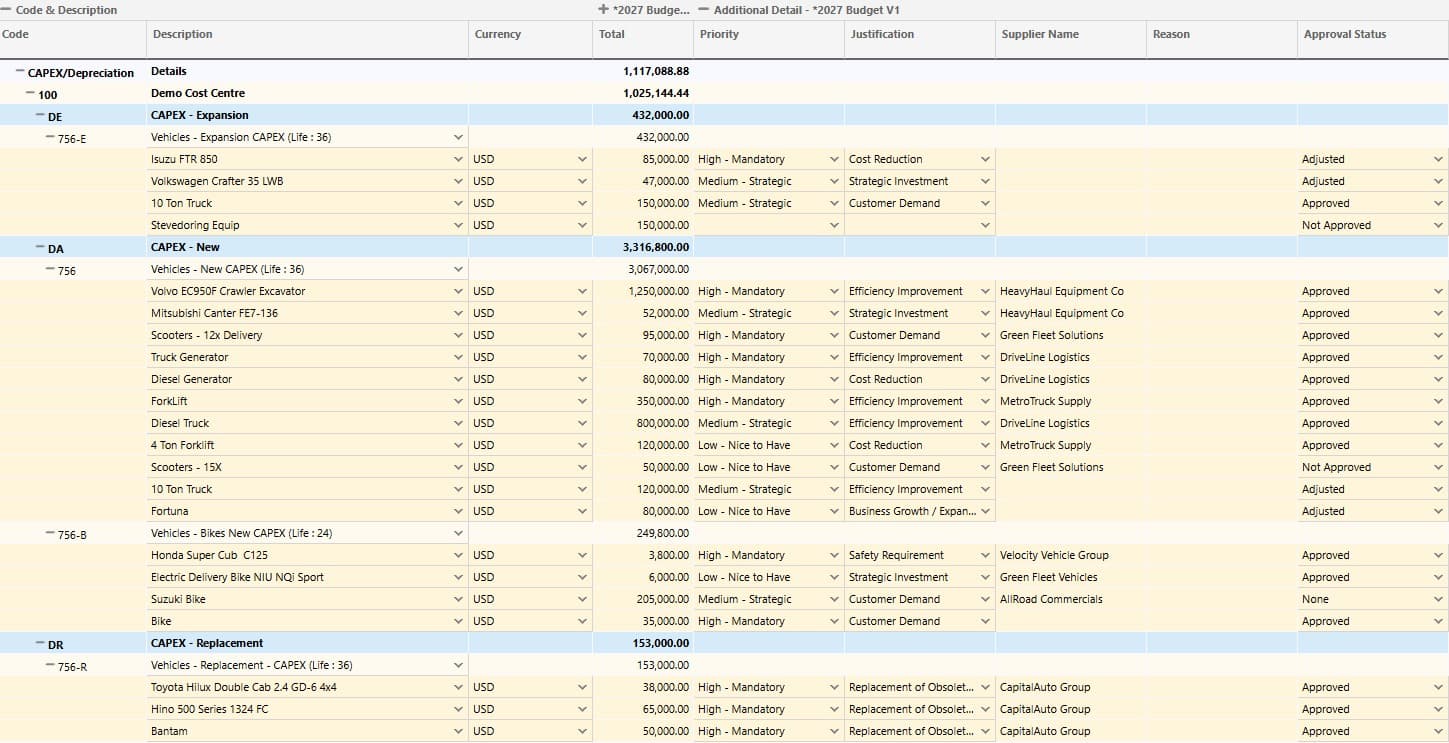
Cost centre managers can capture capex budgets against predefined asset classes and categories, with supporting detail linked directly to the plan. Finance maintains governance and visibility across the organisation.

Automated financial calculations.
Useful life, residual value, depreciation timing, and accumulated depreciation are calculated automatically within the model. Depreciation is allocated to the correct expense, asset, and balance sheet accounts across the relevant periods. Where work-in-progress projects are budgeted, depreciation can begin from the appropriate future date.

Connected to projects and asset management.
Capex planning is connected to both project budgeting and the asset management solution. Project-based capital expenditure can flow directly into the capex budget, while replacement assets and disposals can reference existing assets linked to the cost centre. Using the asset information, IDU automatically calculates depreciation impact and profit or loss on disposal within the financial model.

Capital planning that finance and operations both own.
Alongside the operating plan
Capex lives in the same model as operating costs, ensuring alignment across budgeting, forecasting, and reporting without disconnected spreadsheets.
Detailed planning at cost centre level
Capex can be planned and reviewed at a detailed operational level, giving managers ownership of expenditure while finance retains oversight and control.
Automated financial calculations
Useful life, residual value, depreciation timing, and disposal calculations are handled automatically within the model, reducing manual calculation and reconciliation effort.
Aligned to financial reporting
The impact of capital expenditure flows through to depreciation, balance sheet, cash flow, and forecasting structures automatically, reducing manual reconciliation effort.
FAQs about capex planning with IDU.
How is depreciation budget calculated in IDU?
Depreciation is calculated automatically based on the useful life, residual value, and depreciation timing linked to the selected asset class. The values are allocated to the correct expense, asset, and accumulated depreciation accounts within the financial plan.
How does IDU handle capital expenditure planning?
IDU lets you plan and track capital expenditure within the same platform you use for operational budgeting. The financial picture — budgeted vs actual capex, depreciation modelling, asset register reconciliation — lives in IDU. Procurement processes (purchase requisitions, spend approvals, vendor management) remain in your procurement system.
Can depreciation start at a future date?
Yes. Where work-in-progress or phased projects are being budgeted, the depreciation start date can be delayed to align with the expected in-service date.
Can we track capex projects against their approved budget?
Yes. Once a capex project is approved, IDU compares actual spend against the approved budget at each ERP sync. Finance teams and project owners both have visibility into budget consumption, remaining allocation, and variance.
Does IDU replace our asset register when planning capex?
No. IDU supports capex planning, financial modelling, and asset-related reporting while integrating with the Asset Management module and financial systems where required.
Does IDU calculate depreciation on planned capital assets?
IDU models the financial impact of capital expenditure, including depreciation schedules, on your forward-looking P&L and balance sheet. You see the full downstream effect of capital decisions before you commit.
Can non-financial managers capture capex budgets?
Yes. Cost centre and operational managers can capture capex requirements within a controlled environment, while finance maintains governance and oversight.
Does IDU support approval workflows for capex?
IDU supports approval workflows for transfers between cost centres and for asset disposals. Acquisition-side approvals — purchase requisitions, spend approval — sit in your procurement system. IDU’s role is the financial one: budget, track, compare, and report.
How is capex planning secured and governed?
Access is role-based and configurable. Users can be restricted to specific cost centres or functions, while all changes and approvals are tracked within a controlled and auditable environment.
How does capex planning integrate with our overall financial plan?
Capital expenditure plans flow directly into your consolidated budget and forecast. Cash outflow, depreciation, and balance-sheet impact automatically reflect in the relevant financial statements without double entry.
How are replacement assets and disposals handled?
Users can select existing assets linked to the cost centre when planning replacements or disposals. IDU uses this information to calculate depreciation impact and profit or loss on disposal automatically.
Can we compare multiple capex scenarios before committing?
Yes. IDU’s scenario modelling lets you evaluate different investment options side by side — comparing cash flow impact, ROI, and total cost of ownership — so leadership can make informed capital allocation decisions.

“One of IDU’s key differentiators was how cost-effective the system was, which meant that we could afford to roll the solution out to our entire business.”

“The system is helping us drive business ownership of budgeting and reporting processes.”

Plan capital expenditure with confidence.
Understand the financial impact of every capital decision across depreciation, cash flow, and the balance sheet, before you commit.