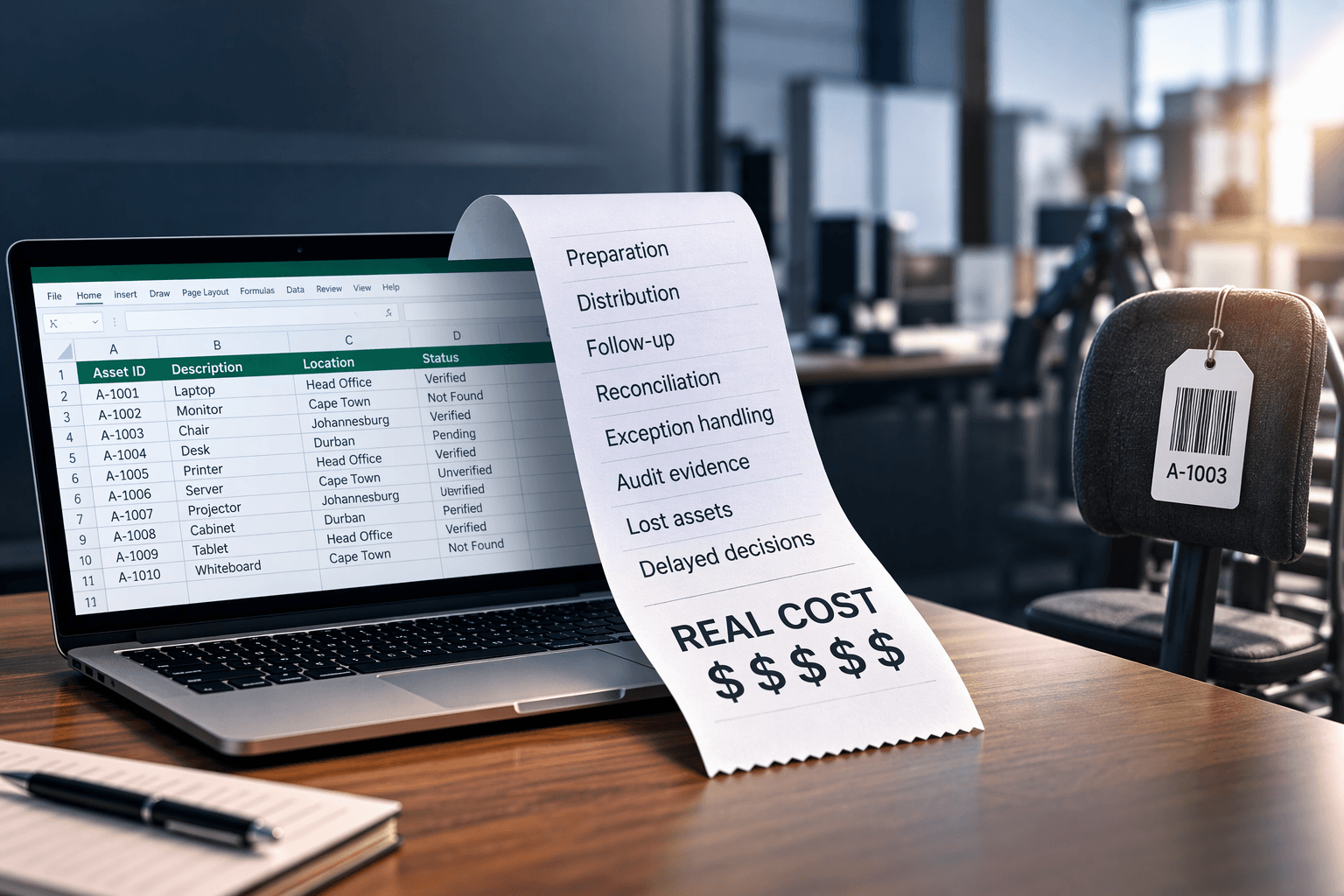
Spreadsheets can make fixed asset verification appear inexpensive. The software is already available, employees understand how to use it, and Finance can divide an asset register extract into files for different departments or locations to complete.
But the process is not free.
The real cost of spreadsheet-based fixed asset verification is distributed across Finance, operational managers, asset custodians, Audit and management. It appears in preparation, physical verification, follow-up, consolidation, correction and evidence gathering. It can also surface in unresolved exceptions, delayed disposals and capital decisions based on incomplete information.
A credible business case should therefore measure more than the spreadsheet. It should measure the operating process that has developed around it.
The spreadsheet is rarely the only manual component
A spreadsheet-based verification cycle can involve a surprising amount of administration.
Finance may need to extract and reformat asset data, divide records by location or cost centre, assign verification lists, distribute files, support users, follow up on responses, consolidate versions, investigate exceptions, obtain approvals, reconcile changes and assemble audit evidence.
The hidden cost is the accumulated effort across these hand-offs.
Where the hidden cost appears
1. Preparing and distributing asset verification files
Before verification begins, Finance often needs to restructure the asset register extract for different companies, asset classes, locations, departments or cost centres.
Files must be named, protected, stored and allocated. Where responsibility is unclear, Finance must also determine who should verify each group of assets.
This work prepares the information for others, but does not improve the underlying asset record.
2. Physical asset verification and locating assets
The physical count consumes time across the organisation.
Verifiers may need to search long lists, match inconsistent descriptions, interpret old location information, identify unlabelled items, record notes and return to locations to check on unavailable assets.
The effort is spread across managers and employees who step away from their normal responsibilities, so the full cost can be difficult to see.
3. Manual data entry and recording verification findings
Physical findings often do not move directly into a controlled process.
Handwritten notes, spreadsheet comments and separate photographs must be interpreted and linked to the correct asset. Someone may need to standardise descriptions, correct location names and create separate transfer or disposal requests.
Each additional entry point creates another opportunity for delay or error.
4. Asset register consolidation and reconciliation
Finance may receive files with changed columns, different statuses, incomplete rows, duplicate submissions, conflicting information or missing approvals.
Determining which information is current is rarely a simple copy-and-paste exercise. Even after consolidation, approved changes must still be reconciled with the ERP or asset register.
The more departments and locations involved, the greater the potential for inconsistencies and additional administration.
5. Tracking outstanding asset verification
Spreadsheets provide limited visibility while verification is under way.
Finance may know that a file was sent, but not whether work has started, how many assets have been checked or which exceptions need attention.
Email, calls and meetings are then used to request updates, clarify incomplete returns and confirm approvals.
A connected process can make completion, outstanding verification and pending actions visible throughout the cycle, rather than relying on manual status updates.
6. Managing unresolved asset verification exceptions
Verification can identify assets that are missing, moved, damaged, duplicated, unlabelled, no longer in use or awaiting transfer or disposal.
A free-text comment identifies the problem, but does not necessarily assign an owner, status or next action.
If follow-up, supporting evidence and approval are not connected, the same issue may require repeated investigation or reappear in the next verification cycle.
7. Audit evidence and fixed asset audit readiness
A final spreadsheet may show a verification status, but not necessarily the entire evidence trail.
Finance may still need to locate the original file, verifier, verification date, photograph, exception explanation, approval and resulting asset register update.
When this history is spread across files and emails, audit preparation becomes a reconstruction exercise.
The time spent retrieving and validating information can be significant, particularly when auditors require evidence for specific assets or exceptions.
8. Outdated information and weak accountability
Normal operations continue while files are being completed and consolidated.
Assets move, custodians change and disposals occur, so information gathered early in the process may be less current by the time final reporting takes place.
A manager's name in a spreadsheet also does not create ongoing accountability if that manager cannot see assigned assets, verification status, exceptions and pending actions.
9. Delayed asset decisions
Poor visibility can affect transfers, disposals and purchases.
An asset may remain against an old location while approval is delayed. A replacement may be requested because an asset cannot be found, even though another location has an idle item.
Verified information does not guarantee that every loss or unnecessary purchase will be avoided, but it provides a stronger basis for investigation and decision-making.
10. Weakly supported CAPEX decisions
Capital expenditure requests should be considered alongside assets already available, current locations, ownership, planned transfers, disposals, replacement cycles, budgets and forecasts.
When fixed asset verification and CAPEX planning sit in separate spreadsheets or systems, decision-makers may not have a connected view of the existing asset base and proposed investment.
Better visibility of existing assets can help Finance assess whether a new purchase is necessary, whether an asset could be redeployed and how proposed expenditure fits into the wider financial plan.
Do not overlook specialist hardware
If verification depends on dedicated barcode scanners, the business case may also need to consider device purchases, replacements, maintenance, storage, administration, training and dependence on a limited pool of equipment.
Standard mobile QR scanning may reduce some of this burden, but scanning should not be treated as the complete value proposition.
The value lies in connecting the scan to the asset record, responsible manager, exception, approval process and financial information.
What should a better fixed asset verification process look like?
The goal is not to remove Excel from every part of asset management. The goal is to ensure that the core control does not depend on disconnected files.
A stronger process should:
- Keep the existing ERP or asset register as the system of record.
- Assign responsibility by location, cost centre or asset class.
- Support direct verification at the asset location.
- Make completion and outstanding work visible during the cycle.
- Surface missing, moved, damaged and unverified assets.
- Route proposed changes through review and approval.
- Retain a traceable verification and approval history.
- Align approved updates with the asset register.
- Connect verified information to CAPEX, budgets and forecasts.
This shifts the emphasis from collecting completed spreadsheets to managing a controlled verification process.
How to assess the real cost of asset verification
The most useful assessment combines direct labour, indirect effort and control-related consequences.
Rather than focusing only on software or hardware costs, organisations should measure:
- People and time: Participants and hours spent on each verification cycle.
- Preparation: Time spent extracting data, preparing files, distributing lists and supporting users.
- Physical verification: Time spent locating assets, checking records and conducting repeat visits.
- Consolidation and correction: Effort required to combine submissions, resolve inconsistencies and reconcile the asset register.
- Exception management: Time spent investigating discrepancies, obtaining approvals and resolving outstanding issues.
- Audit preparation: Time required to retrieve verification records, supporting evidence and approval histories.
- Hardware: Specialist scanner purchases, maintenance, replacements and administration.
- Asset losses and replacements: Historical write-offs, missing assets and replacement purchases.
- CAPEX decisions: The effect of incomplete asset information on purchasing, transfers, disposals and capital planning.
These measures reveal the business case more clearly than the cost of the spreadsheet licence itself.
Frequently asked questions
What are the disadvantages of using spreadsheets for fixed asset verification?
Spreadsheets can make fixed asset verification difficult to manage across multiple departments and locations. Common challenges include manual data entry, version control, inconsistent information, limited visibility of outstanding work, difficult exception tracking and time-consuming audit preparation.
How often should a business conduct fixed asset verification?
The frequency depends on the organisation's size, asset risk, industry and internal control requirements. Many organisations conduct an annual physical verification, while higher-risk or frequently changing asset populations may require more frequent checks. A consistent process and reliable record of verification are essential.
How can businesses improve fixed asset verification?
Businesses can improve fixed asset verification by assigning clear responsibility, maintaining an accurate asset register, recording physical findings consistently, tracking exceptions, controlling proposed changes through approval workflows and retaining supporting evidence. Connecting verification activities to the asset register helps reduce manual reconciliation and improve visibility.
From hidden effort to visible control
Spreadsheet-based verification often appears inexpensive because its costs are absorbed into existing roles. Finance prepares files, managers verify assets, custodians investigate exceptions, Audit requests evidence and management reviews capital proposals. No single cost centre necessarily sees the complete burden.
A connected process makes the work and control visible. Responsibility is clear, progress can be monitored, exceptions have a status, changes are approved, evidence is retained and verified information can support financial decisions.
That is the shift from spreadsheet administration to operational asset control.
What does your current asset verification process really cost?
Understanding the time, resources and effort involved is the first step towards improving the process.
Book an IDU Asset Verification Process Review to explore your current files, hand-offs, approvals and reconciliation activities, and identify opportunities to improve visibility, accountability and control.